
Gallery 2
The Connected Vessel
6 May - 17 May 2026
Opening night
8 May | 6 - 8 pm
Gallery Hours:
Wednesday – Sunday: 10 am – 5 pm (please note last day of exhibition ends at 3 pm)
Group Statement
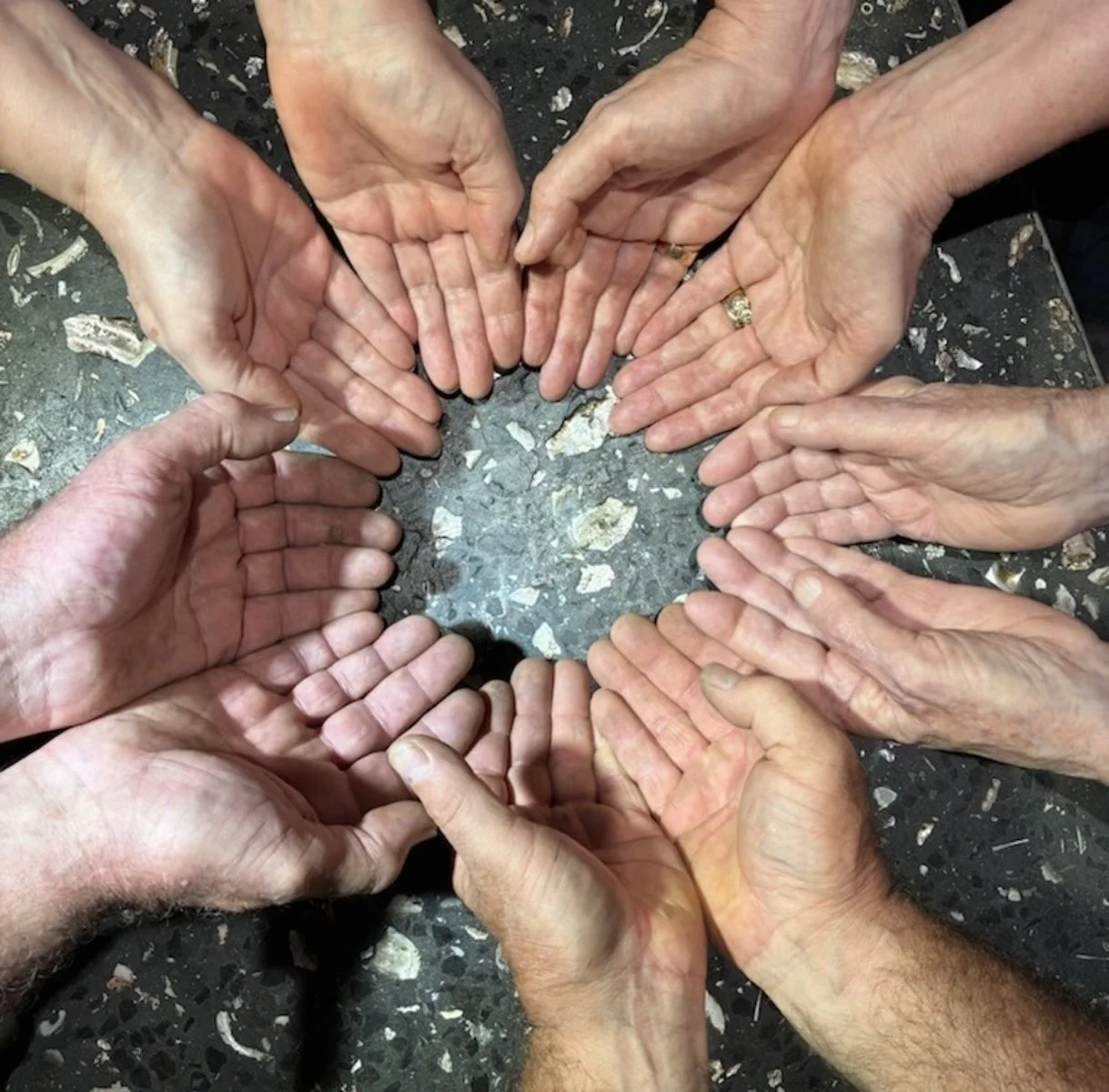
Through decades of shared experiences, exploration, and sustained creative practice, these 5 artists have developed an enduring connection grounded in a collective commitment to material inquiry. This exhibition offers an opportunity to revisit earlier works alongside recent outcomes, tracing the evolution of individual and shared practices while revealing the formative influences that continue to shape their thinking and making.
Returning to Red Gallery as part of Radiant Pavilion; the Melbourne Contemporary Jewellery and Object Biennial, the presentation of Our Past is Present reflects both continuity and change. The exhibition foregrounds the artists’ long-term relationships and engagement with process, material, and making, extending their individual and collective approaches while deepening their dialogue with the material world.
Artists: Deborah Sullivan, Ian Ferguson, Karl Millard, Lynley Traeger, Mark Edgoose
Deborah Sullivan
Artist Statement
Deborah Sullivan is a Melbourne artist and craftswoman working predominantly in precious metals and gemstones. Also in watercolour and acrylic paint. In her metal work, she adapts ancient techniques to explore the complexities of personal and collective history and identity in a contemporary setting. Inspired by pre-Christian and medieval Irish mythology and by imagery drawn from Mere Irish (Bog) folk narrative, her work addresses aspects of trauma and violence, and the possibilities of healing and redemption.
The reassurance of ritual associated with the brass teapot and tea strainer, for instance, is shadowed by the threat of sexual assault in the stories that underpin ‘Brigid and the Coin’. Like the lotus emerging from the mire and in ‘The Gift for Léila’, the human capacity for transformation is also reflected here, culminating in the chalice that holds the promise of life in death, of the sun rising from the depths of grief.
The pieces exhibited here are a series of one-off, hand-raised, planished and carved works produced between 1981 and 2010 as she became more and more interested in the submerged elements of my own history as a contemporary Australian jeweller and silversmith confronting her Irish/Australian heritage and inheritance.
Artist Biography
Deborah Sullivan studied Gold and Silversmithing at the Royal Melbourne Institute of Technology (1981-84) where her teachers and mentors included Robert Baines and Hendrik Forster. She was awarded a De beers Diamond Design award (1981)
After graduation, she worked for a number of Melbourne-based jewellers and had studios in Fitzroy and the Nicholas Building. Her work has been shown widely in Australia, including the Celtica Exhibition at the Rocks, Sydney (1992), 'The Pearl Fishers' exhibition at the Victorian Arts Centre (1995) and 'Sgiathán Dearg and Daughter of the Western World' at the Hobart Writers' Festival (1996).
Drawing on Jungian psychology and the symbolic language of vernacular folk narrative and mythology, her work seeks to integrate tradition and modernity in a contemporary Australian context.
Ian Ferguson
Artist Statement
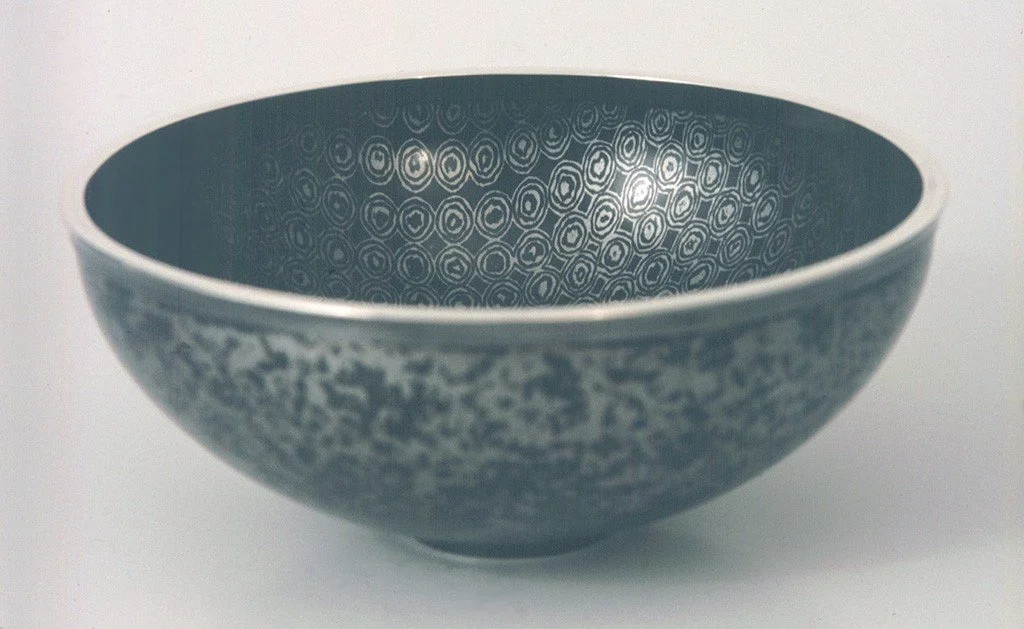
Since the beginning of the artist’s silversmithing career, he has been making objects of a personal symbolic significance that are (but not always) the abstract expressions of experiences, perceptions, ideas and emotions. These objects have an almost formal ceremonial nature, which are intended for contemplation and reflection and generally take the form of containers or bowls. He recognised the whiteness and purity of silver as a peculiar propensity to accentuate and brighten other colours and employs other materials to explore this dynamic and express the intentions of the object.
In particular, he has studied the Japanese technique of Mokumé Gane (woodgrain metal), which suited this quest for pattern and colour. The material can be produced in such a vast range of combinations, colours and patterns that no two pieces are the same, which presents a great challenge in that every new piece is a new experiment - each bowl is unique; indeed, it seems possible to make bowls forever without repetition.
Artist Biography
Born in 1945 in Perth, Western Australia.
Currently practising as a silversmith, Ian Ferguson has previously held Research Fellowships at the University of Manchester (2002 – 2004) and the Royal Melbourne Institute of Technology (1997-2000). He graduated with a Dip of Fine Art from RMIT in 1983 and gained his PhD in 1996 from the Royal College of Art, London, for his research into the application of modern metallurgical knowledge to the manufacture of the traditional Japanese metals called Mokumé Gane. This research has led to the development of several new Mokume Gane metals. He has won several research grants, notably from the Leverhulme Trust and the Australia Council. Since his graduation in 1983, he has participated in 59 exhibitions in Australia, Japan, the U.S.A., Asia, and Europe.
He is represented in various private collections in Australia, New Zealand, U.S.A., Great Britain and Japan, and in the public collections of the Royal College of Art, Science Museum, Victoria & Albert Museum, National Museums of Scotland, Silver Trust National Collection of H.M. Government in the U.K.; Royal Melbourne Institute of Technology, Hamilton Regional Art Gallery and City of Banyule Art Award Collection in Victoria; and the South Australian Art Gallery.
Ian Ferguson has retired from silversmithing due to ill health, although he still potters about.
Karl Millard
Artist Statement
Maintaining a workshop practice, continuing as a cultural tool, making and the workshop practice of understanding and investigation. How humans handle objects, making objects for everyday use, primarily pepper grinders, how hands interact with a functional object and how the object becomes the handle. My interest is in how we pick up objects from a horizontal surface. How interesting the shape is for our hands to handle. And the enjoyment of enjoying the act of making new shapes in metal.
Artist Biography
Karl Millard is an established Australian jeweller and metalsmith who has maintained an independent practice since 1987, working across fine metal jewellery and contemporary silversmithing. He holds a Master of Arts by Research from RMIT University and a Bachelor of Arts from Chisholm Institute of Technology (now Monash University), both specialising in gold and silversmithing. His practice is informed by international experience, including residencies and projects in India, Thailand, Italy, and Malaysia, alongside collaborations with designers and industry partners.
Millard’s work has been exhibited widely in Australia and internationally, including at the National Gallery of Australia, the Victoria and Albert Museum, and the Shanghai Museum. Solo exhibitions span Australia, India, and Malaysia, while group exhibitions include major surveys of contemporary craft and design. He is the recipient of multiple grants and awards, and his work is held in significant public and private collections.
Lynley Traeger
Artist Statement
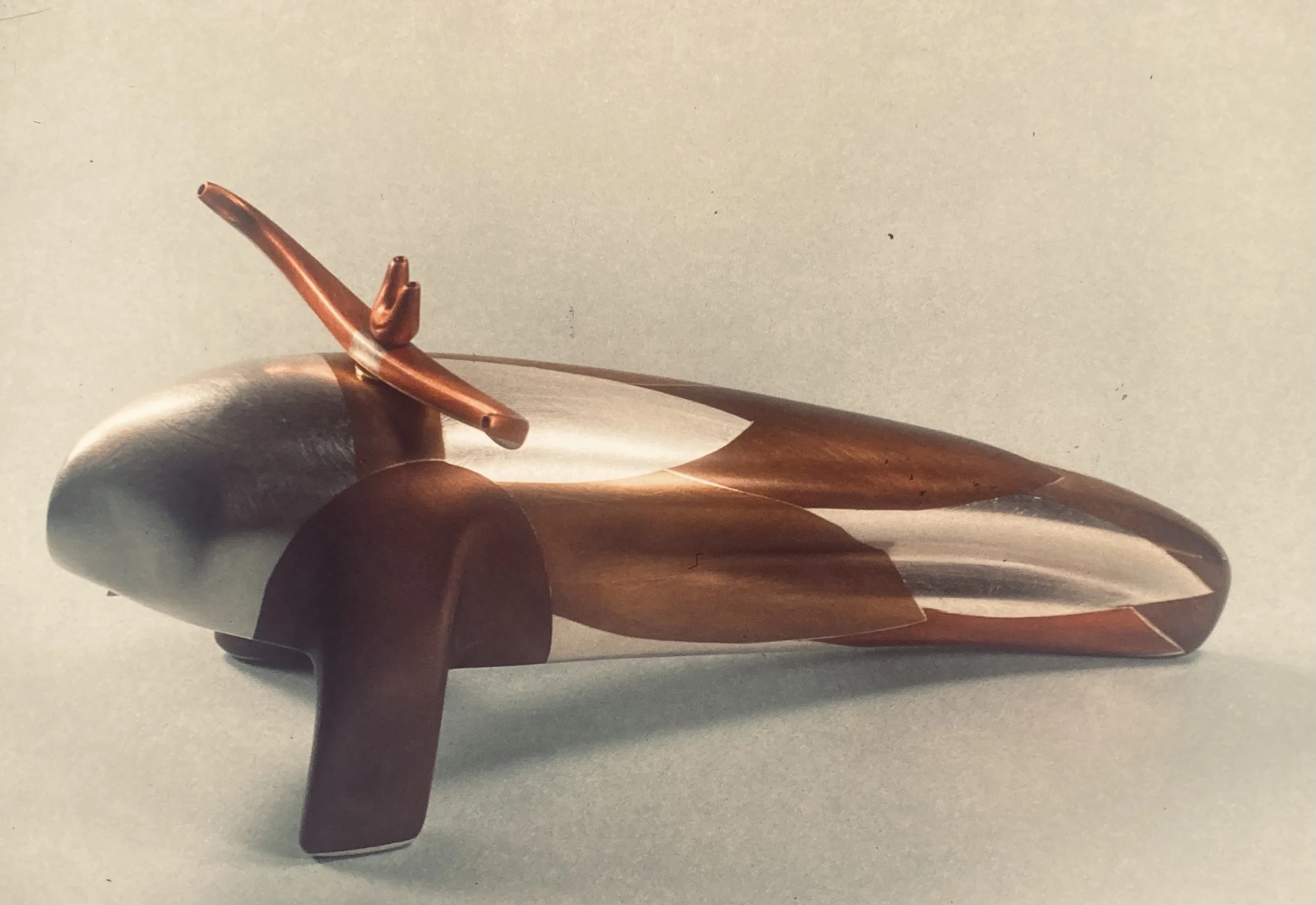
Lynley’s practice is grounded in an ongoing investigation into the flexibility of design ideation, material, and technique. Working across jewellery and objects, she produces one‑off works—including walking sticks, jewellery forms, and an animated egg teapot—that offer a reflective view of an evolving creative enquiry. Each work functions both independently and as part of a broader narrative, revealing shifts in process, thinking, and making over time.
Central to her approach is the belief that making itself generates knowledge. With sustained experimentation of diverse materials and technical processes, Lynley examines the relationship between form and function, seeking balance between use, wearability, and visual presence. The works invite interaction, prompting consideration of how objects might be held, worn, or encountered in everyday life.
Operating between the tactile and conceptual, Lynley challenges distinctions between utility and adornment, inviting reflection on how art can extend beyond conventional boundaries. With a longstanding practice, she has been designing and making since studying Gold and Silversmithing at RMIT (1981) and a Master of Arts by Research at Monash University (2004). A sustained teaching career at Melbourne Polytechnic and over 25 years of professional studio practice in Melbourne’s Nicholas Building inform her rigorous and materially driven approach to making.
Artist Biography
With over 40 years in contemporary jewellery and object practice, Lynley designs and handmakes unique pieces. Studies in Gold and Silversmithing at RMIT in the 1980s, a Post Graduate Diploma of Arts in Jewellery and Metals from Monash University (Mornington Peninsula) in 1998, a Master of Arts by Research from Monash University (Caulfield) in 2004, and with a studio in the Nicholas Building for over 25 years, have left an indelible mark on her skills and her place in the community of practice in Melbourne. With her work collected and awarded through various exhibitions, her passion led to teaching Jewellery and Object Design at Melbourne Polytechnic, where she has been sharing invaluable skills for 25 years.
Mark Edgoose
Artist Statement
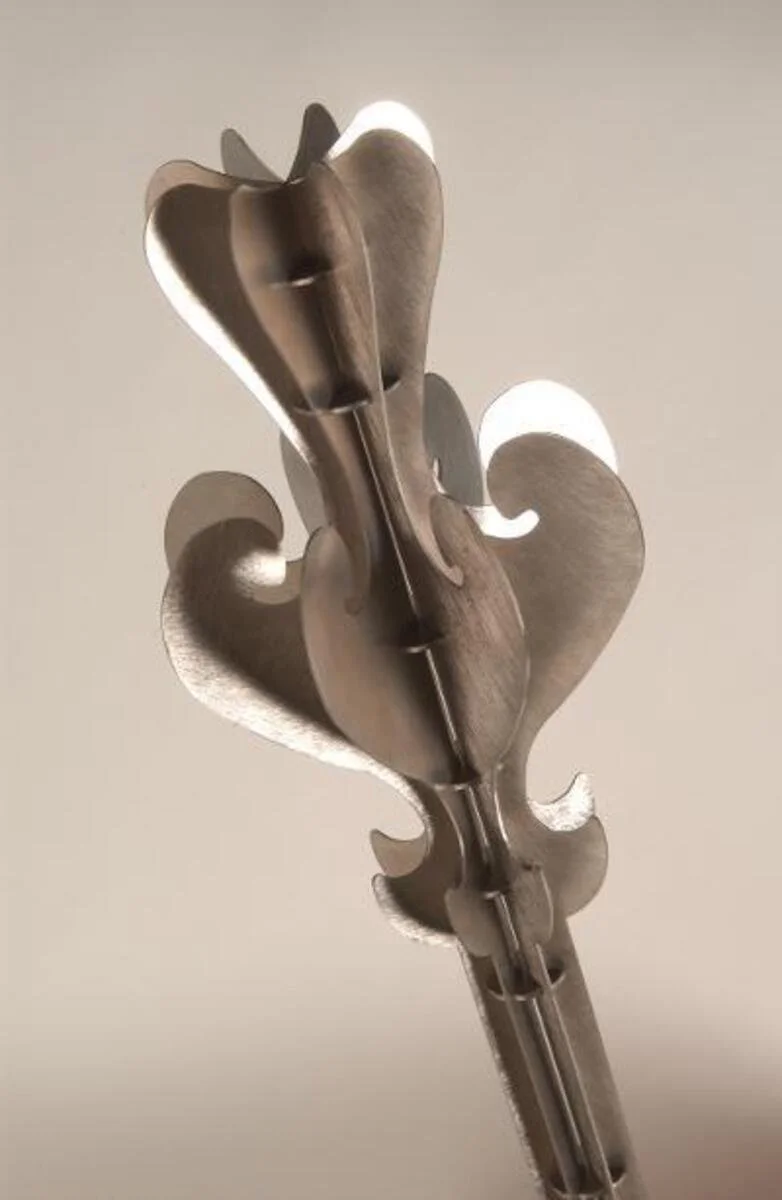
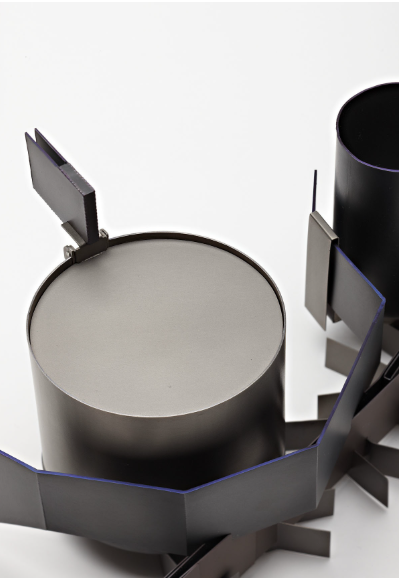
Mark Edgoose’s object-based practice operates at the intersection of craft, design and architecture. The notion of containment and functional ambiguity is fundamental to his work. By extending, stacking, assembling and connecting various components, Edgoose creates linear works with a distinctly industrial aesthetic that is reflected in the cool grey titanium that is his preferred material.
In his Rail Series, works are characterised by the essential relationship to the architectural environment in which they are installed, highlighting Edgoose’s abiding interest in objects and space that connect and create relationships between themselves, to their environment, and to the viewer.
Mark Edgoose’s practice investigates how craft objects exist, extend and pertain to space and time. It examines the craft object in the context of exhibition practice, and in terms of how the relationships between object, space and time can be activated, and how the significance of the object itself can shift. His practice focuses on thinking about, and experimenting with, possible new significations beyond traditional notions of the craft object as a self-contained entity. From a background in jewellery and object-making, he seeks to locate the activation of meaning through forming and situating the craft object in a given context. He also seeks to explore how and when such placements can activate understandings of time and space through experience.
Edgoose’s practice is influenced by his interest in architecture, where issues of site, function, material processes, use and occupation are fundamental considerations within accepted architectural design practice and theory. This, coupled with his experience in craft practice as an exhibiting artist in gold and silversmithing, provides the impetus for his research. In particular, he is interested in the ways form, detail, location, presentation, material production and encounter can activate meanings for the craft object through its relationship to both the exhibition space and domestic setting. To focus this enquiry, his practice involves the making of a series of works centred on the exhibition and commission of rails as craft objects, leading to a series of ‘domestic rails’ in which the works connect with, function within and influence domestic architectural spaces. These ‘domestic rail’ works involve rail forms and secondary ‘objects and silhouette’ mounted on them.
Artist Biography
Mark Edgoose is a Naum/Melbourne-based craftperson, artist and academic. His work has been shown nationally and internationally in major exhibitions and continues to make a significant contribution to Australian object-making. His practice works at the intersections of craft, design and architecture, and his material-driven research is fuelled by an interest in the metaphor of objects using both traditional and hi-tech materials and processes.
The notion of containment and functional ambiguity is fundamental to his work. By extending, stacking, assembling and connecting various components, Edgoose creates linear works with a distinctly industrial aesthetic that is reflected in the cool grey titanium that is his preferred material.